

Shedd story
The hidden cost of donation drop-offs for small businesses
October 26, 2026
Quick answer
Clothing donation drop-offs can create hidden costs for small businesses when bags overflow, occupy customer space or leave staff responsible for cleanup. Shedd Hub offers a different model: local businesses accept and scan sealed clothing bags for Shedd’s resale service, store them behind the counter or in a back room, and earn per bag with daily courier pickups.
What do clothing donation drop-offs really cost a small business?
A clothing donation corner can begin as a generous gesture: make it easier for neighbors to clear their closets and support a good cause. But if the arrangement lacks clear boundaries and dependable collection, the shop can become responsible for much more than providing a little floor space.
Someone has to move the bags, answer questions, keep walkways clear and deal with anything left outside the designated area. Those tasks compete with serving customers and running the business.
Shedd Hub changes that arrangement. It is a network of local businesses that accept sealed clothing bags from sellers using Shedd, the resale marketplace at shedd.app that sells people’s clothes for them. Rather than hosting an open-ended donation pile, partners follow a defined bag check-in process and receive per-bag compensation.
Why can the traditional donation model leave businesses with the mess?
The problem is not generosity. It is the gap between accepting clothing and having a reliable plan for what happens next.
A donation bin has a physical limit, but people arriving with bags may not know whether it is full or when collection is due. If they leave clothing beside it anyway, the host business faces an immediate decision: bring it inside, leave it exposed or contact the collection organization.
For a small shop, the hidden costs can include:
- Staff attention: Employees interrupt their regular work to answer drop-off questions or relocate bags.
- Lost usable space: Clothing can crowd an entrance, counter or storage area needed for the business.
- Cleanup work: Loose garments, torn bags and abandoned packaging need attention.
- Customer confusion: Visitors may expect the host business to explain donation policies or collection delays.
- Reputational friction: A messy collection point can reflect on the storefront, even when another organization handles the clothing.
These problems are not inevitable at every donation site. A well-managed charitable collection can work well. But a business should not confuse “no hosting fee” with “no operational cost.”
Do donated clothes always reach someone who will wear them?
Not necessarily, and the destination depends on the receiving organization and the clothing’s condition. Donation does not automatically mean a garment goes directly to a local person. Depending on the collection system, clothing may be resold, shipped overseas, recycled or ultimately landfilled if it cannot be used or processed.
Overseas shipment is not automatically waste, and it would be inaccurate to say every donation ends in landfill. The practical issue for a storefront is visibility: staff may have no reliable answer when someone asks where a particular bag will go.
There is also a difference in what the person dropping off clothing receives. A charitable donation is not a resale transaction; the donor generally does not receive sale proceeds. That may suit someone whose goal is giving. Someone hoping to recover value from their wardrobe needs a different service.
Shedd provides that alternative by selling people’s clothes for them. It is a resale route, not a promise that every garment will sell or that no clothing will ever become waste.
What does an overflowing donation corner look like in practice?
Imagine a small South Florida café on a busy morning. This is an illustrative scenario, not a report about an actual business.
A customer arrives carrying a clothing bag and points toward the café’s donation corner. The bin is already full. Another bag leans against it, and a sleeve trails across the floor. A staff member steps away from the register to move everything out of the walkway.
Then comes the question: “Will these clothes go to someone nearby?” The employee does not know. The café hosts the bin, but it does not control sorting or distribution. By the time the line clears, the owner has another task: find out when the pile will be collected.
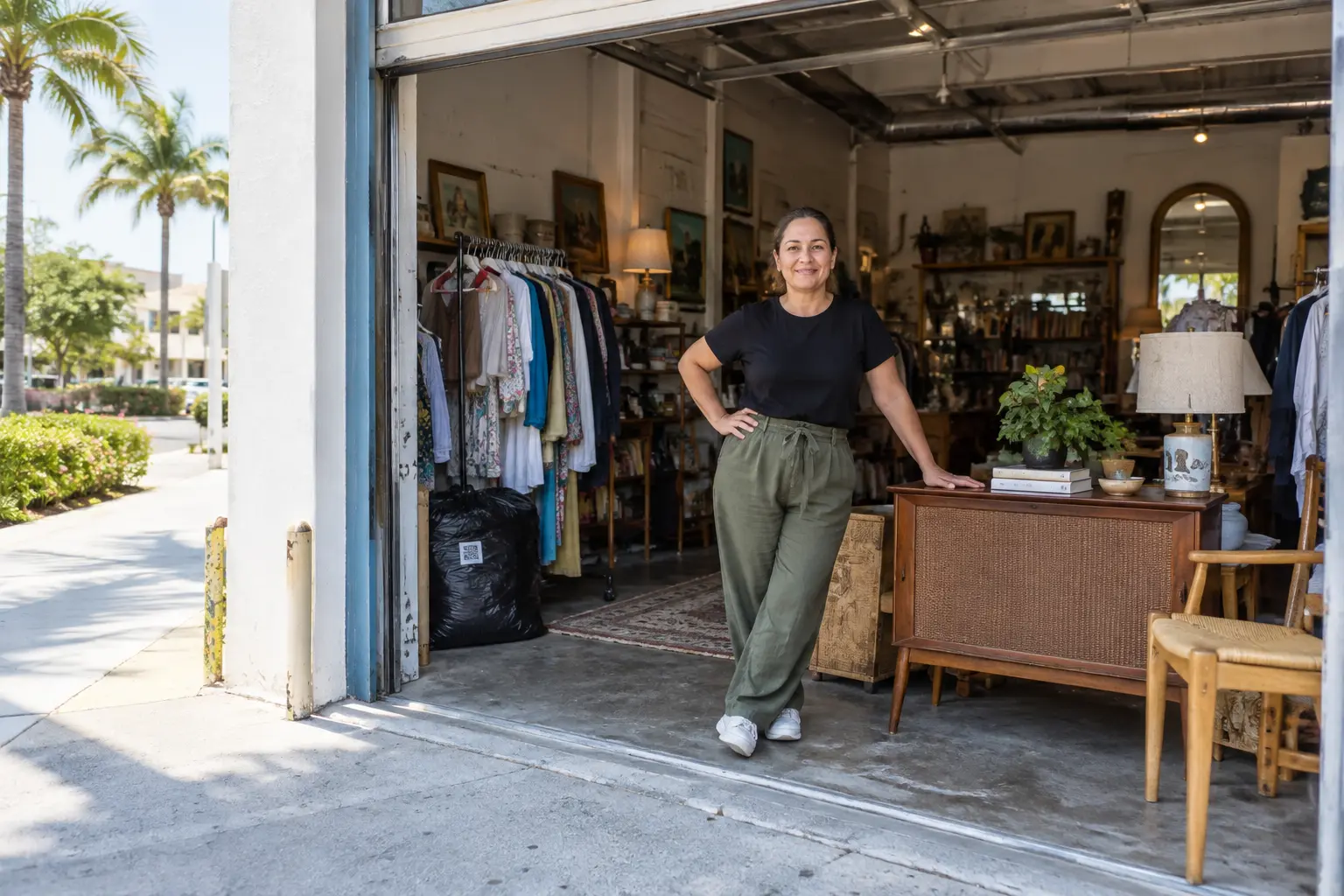
Now picture that café operating as a Shedd Hub instead. A Shedd seller brings a sealed clothing bag. The partner scans each bag at check-in, using the free preprinted QR labels provided, one per bag. The bag goes behind the counter or into a back room—not beside the tables. Daily courier pickups provide a regular collection rhythm.
The café still has responsibilities. It needs staff who can handle check-in and suitable storage. But the work has a defined purpose, a defined location and a per-bag payment attached to it.
How does Shedd Hub address the hidden costs?
Shedd Hub replaces an informal donation corner with a specific role in Shedd’s resale service.
How are bags checked in and stored?
Partners accept sealed clothing bags and scan each bag at check-in. Shedd Hub provides free preprinted QR labels, with one label per bag.
Bags are always stored behind the counter or in a back room, never in the customer area. That requirement matters: becoming a partner should not mean turning seating, aisles or display space into a collection zone.
Most bags contain 11–20 items, weigh about 10–20 pounds and are roughly the size of one kitchen trash bag. Owners should assess their actual back-of-house capacity rather than assume bags will fit somewhere.
How often are bags collected?
Shedd Hub has daily courier pickups. That addresses a central weakness of loosely managed collection arrangements: uncertainty about when accumulated bags will leave.
Daily collection does not remove the need for storage planning. A partner still needs room for bags between pickups. See how Shedd Hub works before deciding whether the workflow suits your shop.
How does the business get paid?
Partners earn by the item count in each bag:
- Up to 10 items: $2 per bag.
- 11–20 items: $2.50 per bag.
- 21 or more items: $3 per bag.
Payments are made once a month, and setup costs $0.
For a hypothetical, not guaranteed income example, suppose a shop accepts 20 bags per week, all containing 11–20 items. That is 20 × $2.50 = $50 per week, or $200 across a four-week month. Actual earnings depend on bag volume and item counts; owners should also consider staff time and storage when assessing the benefit.
Is Shedd Hub the right replacement for your donation corner?
If your purpose is specifically charitable giving, resale is a different choice—not an interchangeable substitute. But if customers want a convenient way to pass on clothing while pursuing resale value, Shedd offers a service designed around that goal.
For the host business, the key distinction is operational: sealed bags, individual scans, designated storage, daily pickups and compensation instead of an undefined obligation to manage a pile.
Shedd Hub is launching in South Florida, including Miami, Fort Lauderdale, Boca Raton and West Palm Beach. Sellers can find participating shops. Business owners with questions can contact info@shedd.app.
Ready to become a Shedd Hub Partner?
Give clothing drop-offs a defined place in your business—not your customer area. If you have suitable behind-the-counter or back-room storage and can manage bag check-ins, apply to become a Shedd Hub Partner.
Key takeaways
- Donation drop-offs can consume staff time, usable space and cleanup effort even when hosting appears free.
- Donation destinations vary; not every garment is distributed locally, and not every donation becomes waste.
- Shedd sells people’s clothes for them, while Shedd Hub partners accept and scan sealed seller bags.
- Partners receive $2–$3 per bag, monthly payments, daily courier pickups and free QR labels, with $0 setup.
- All bags must stay behind the counter or in a back room, never in the customer area.
Frequently asked questions
Is Shedd Hub a clothing donation service?
No. Shedd Hub businesses accept sealed bags from Shedd sellers. Shedd is a resale marketplace that sells people’s clothes for them, rather than a charitable donation service.
How much do Shedd Hub partners earn per bag?
Partners earn $2 for bags with up to 10 items, $2.50 for 11–20 items and $3 for 21 or more items. Payments are made once a month. Total income depends on bag volume and item counts.
Where do businesses store Shedd bags?
Bags must be stored behind the counter or in a back room, never in the customer area. Most bags contain 11–20 items and are roughly the size of one kitchen trash bag.
How does Shedd Hub handle check-in and collection?
Partners scan each sealed bag at check-in. Shedd Hub provides free preprinted QR labels, one per bag, and daily courier pickups.
Where is Shedd Hub launching, and how can a business apply?
Shedd Hub is launching in South Florida, including Miami, Fort Lauderdale, Boca Raton and West Palm Beach. Businesses can apply at /apply or contact info@shedd.app with questions.
Earn $2–$3 per bag at your business
$0 setup, Shedd-coordinated collection, paid monthly.
Become a Shedd Hub Partner